Facelift
Rejuvenate without transforming · Vevey & Lausanne
The facelift: rejuvenating without transforming.
A facelift redefines the oval shape of the face, firms the neck, and erases signs of sagging. The face appears rested, about ten years younger, and still looks like your own.
An anatomical surgery. Over time, it's not just the skin that sags: the deep muscular layer, the SMAS, slides downwards, pulling the jawline down with it. The modern facelift realigns this layer, removes a minimal amount of skin, and places the scars behind the ear and in the hairline.
Soft lifting. For moderate skin laxity, from around age 45, a short-scar facelift tightens the skin and slightly repositions the structures. It is performed under local anesthesia, without hospitalization, at the RIVIERAclinic from Vevey.
A cervicofacial lift. When sagging affects the cheeks, jowls, and neck, a full facelift repositions the lower third of the face. The scar may extend to the temple to lift the angle of the eyes. It is often combined with blepharoplasty and the reinjection of your own fat in microfat or nanofat form to restore volume and skin quality.
Facelift before and after: a restored oval shape.


© Dr Smarrito – All rights reserved. Photographs of Dr.'s patients Smarrito, published with their consent; faces masked or cropped. Results vary from person to person.
The new facelift, a 3D facelift.
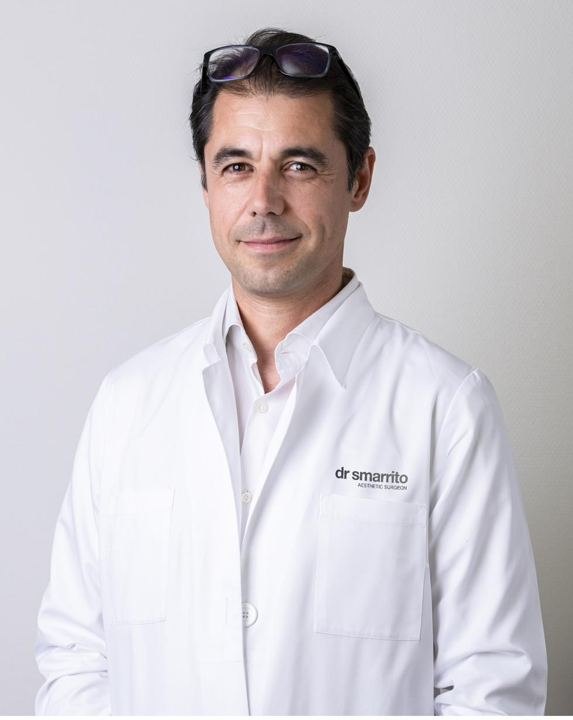
Doctor Smarrito He learned the facelift technique in Paris, in the department of Professor Mimoun, where he was the surgical assistant of Dr. Mitz, to whom we owe the description of the SMAS. Twenty years later, his facelift remains faithful to this school: respecting the skin, restoring the anatomy that has shifted, restoring lost volume with fat, and supporting the skin with regenerative medicine (PRP, SVF, stem cells).
A rejuvenated face, never a drawn face.
Four biases that guide each of Dr.'s facelifts Smarrito.
More than twenty years of facial surgery.
Training at the Parisian school of facelifting, daily practice between Vevey and Clarens-Montreux.
Doctor Smarrito explains the facelift.
Soft lifting or cervico-facial lifting, scars, aftercare: find the surgeon's explanations on his YouTube channel.
Rates and practical information
Practical information
- Private consultation, 30 minVevey
- Duration of the intervention2 to 3 hours (full facelift)
- AnesthesiaLocal (soft lifting) · General light (full facelift)
- TripSame day · 1 night (fully booked)
- Edema and bruising7 to 10 days.
- Removing the wiresDay 8 to 10
- Flight24 h · 72 h (fully booked)
- Back to workDay 10 to 14
- Return to sportWeek 3 and 4
Prices
Indicative prices, subject to change depending on demand, complexity, and the chosen clinic. The consultation includes the provision of a detailed surgical estimate.
Facelift FAQs
Soft lifting or full facelift: which to choose?
A full facelift, or cervicofacial lift, offers a more comprehensive solution: it addresses sagging skin and deep muscle tension in the cheeks, jowls, and neck. It is performed under light general anesthesia, requiring an overnight stay at the clinic.
A soft facelift is simpler: a short scar, local anesthesia, and you can go home the same day. It's suitable for moderate sagging and costs about half the price of a full facelift. The choice is made during a consultation, based on your anatomy, your expectations, and the recovery time you have available.
Am I a good candidate for a soft facelift?
It depends on your anatomy and what you wish to correct. A soft facelift gives excellent results from around age 45, when the sagging is still moderate. Budget, apprehension about general anesthesia, and a short recovery period are also factors to consider.
For a very localized sagging of the cheek, Dr. Smarrito also offers a localized 45-minute facelift under local anesthesia, the One Stitch Face Lifting, with very little downtime.
How is a facelift performed?
A full facelift typically takes two to three hours under light general anesthesia at Clinique La Prairie. An overnight observation period is scheduled, particularly to check for any hematomas within the first 24 hours. A semi-compressive dressing is applied at the end of the procedure.
The soft lifting procedure is performed under local anesthesia at the RIVIERAclinic from Vevey. You will remain under observation for one to three hours, then return home accompanied or by taxi: driving is not permitted on the day of the intervention.
Are the facelift scars visible?
They are placed in the most discreet areas: in front of and behind the ear, inside the ear, and in the hair. A minimum amount of skin is removed, which limits the tension on the sutures.
Scars generally fade within about six months. If necessary, a minor touch-up can be offered between six and twelve months.
Is a facelift painful? How can swelling be reduced?
A facelift is not a painful procedure. Discomfort during the first 24 hours is mainly due to the semi-compressive dressing; a simple pain reliever is prescribed if needed.
To reduce swelling: wear a semi-compression mask, sleep with your head elevated, apply cold compresses without direct contact with the skin, and eat soft foods on the first day. Bruising is most common during the first week.
How long does the result of a facelift last?
A facelift can make the face look about ten years younger. On average, a soft facelift needs to be repeated after five to seven years, and a deep facelift after ten to fifteen years.
The duration depends on skin elasticity, weight stability, menopause, and lifestyle; smoking shortens it. Hyaluronic acid injections or Morpheus8 sessions can maintain the result.
At what age should you get a facelift?
Most facelifts are performed between the ages of 45 and 65. There is no strict age limit: your health is the determining factor. A second facelift is possible years later.
What are the contraindications?
Treatments that thin the blood (anticoagulants, aspirin, anti-inflammatories), certain heart or lung diseases, poorly controlled diabetes, a skin tumor, or a serious condition require careful evaluation. A temporary discontinuation of certain treatments may be considered in consultation with your cardiologist or primary care physician.
Smoking increases the risk of impaired wound healing: quitting is strongly advised before and after the procedure.
Does a facelift erase wrinkles? Can you beautify your face without a facelift?
A facelift primarily corrects sagging skin and redefines the facial contours; it is not intended to erase fine lines. These are treated separately with skin boosters, picosecond lasers, or Morpheus8, and wrinkles around the mouth with mesotherapy and hyaluronic acid.
As long as the sagging remains mild, hyaluronic acid, lipofilling or nanofat grafting using your own fat, radiofrequency, or a peel are often sufficient to enhance the face and refine the jawline. When volume no longer compensates for tissue sagging, a facelift, either full or limited to the lower face and neck, becomes necessary. For information on facial or body skin laxity, see also the article on skin laxity.
When will I be able to fly or tie my hair back?
Flying is possible after twenty-four hours for a localized facelift and after seventy-two hours for a complete facelift, on the advice of the surgeon.
Hair can be tied up the next day, but a ponytail will show the stitches and bruising for about ten days. The stitches are removed between the eighth and tenth day.
This information is not a substitute for a consultation with Dr. Stéphane SmarritoEvery face is different; the treatment plan is developed in the office.
A rested face, still yours.
Soft lifting under local anesthesia at the RIVIERAclinic, or a complete facelift with an overnight stay at Clinique La Prairie: a private treatment, personally monitored by Dr. Smarrito.